Skip to project
pedromartins.tech
Complete
Computer Vision / Desktop App2025

OWCoach

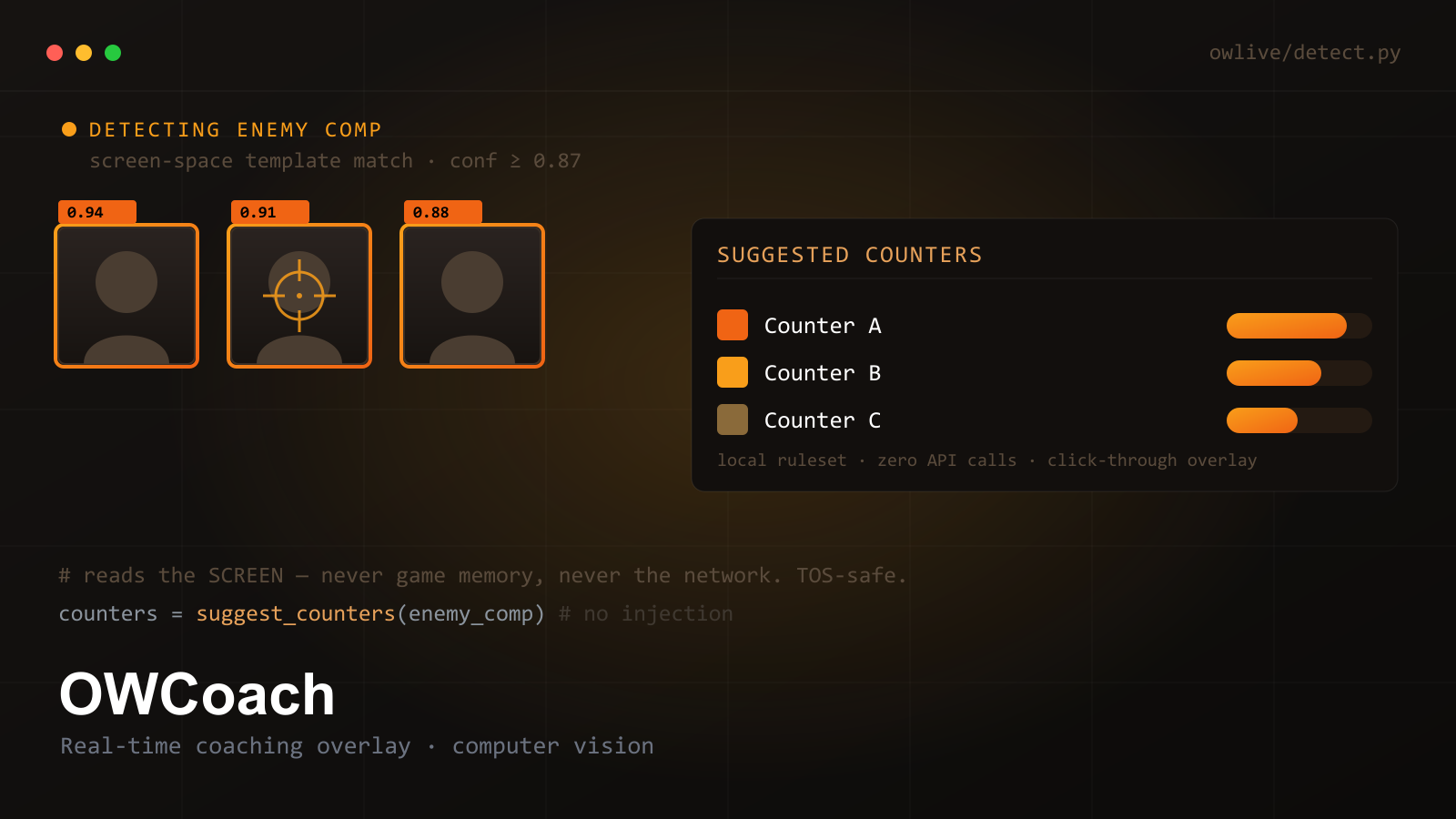
Produced real-time coaching suggestions from screen pixels alone-without process-memory access, injection, or live network dependence.
Role
Computer vision and desktop application engineer
Environment
Windows desktop · Local inference
Ownership
Capture · Calibration · Template matching · Rules engine · Overlay · Packaging
OWCoach project visual
owcoach-vision5 system boundaries
Game Screen
Screen Capture
Template Matcher
Counter Rules
0.87template-match confidence threshold
0game-memory reads
0network calls during play
Localcounter-rules execution
01 / Interactive system

Move through the system layer by layer

owcoach-visionWindows desktop · Local inference · Read-only
Complete
System map

Boundaries and responsibilities

Public or untrustedAuthenticated boundaryInternal-only dependency
READ-ONLYWindows desktop · Local inferencetool: systemselection: screen

Game Screen selected.

02 / Context

The problem behind the system

A useful coaching overlay needs to understand the visible match state without crossing into game-process inspection or intrusive client behavior.

OWCoach treats terms-of-service safety as an architectural constraint: it reads the screen, evaluates a local ruleset, and renders a click-through recommendation surface.

Read the full project overview

A real-time Overwatch coaching overlay that reads the game screen - not its memory - to recommend hero counters as a match unfolds. A Python detection engine captures the scoreboard/killcam region, matches hero portraits with template matching, infers the enemy composition, and renders click-through suggestions through an Overwolf overlay. Packaged as a standalone Windows desktop app.

SAFE BY DESIGN - The whole thing is deliberately screen-space only. It never reads or writes game process memory, never injects into the client, and makes zero network calls during play - so it is not a cheat and stays inside the game's terms of service by construction. The counter logic is a local ruleset; nothing about the player's session is uploaded.

ENGINEERING - Auto-calibration locates the relevant HUD region across resolutions, template matching runs above a 0.87 confidence threshold to avoid false positives, and the overlay stays click-through so it never intercepts input. The build ships as a PyInstaller executable with a desktop shortcut and icon, plus a small stats-fetcher that pulls aggregate hero data offline.

03 / Decisions

The trade-offs that shaped the build

Decision

Screen-space only

Use what the player can already see.

Reason
Avoid process inspection, injection, and hidden game-state access.
Trade-off
Visual detection is less reliable than direct internal data.
Revisit when
Never toward memory access; only improve the visual pipeline.
Decision

Local rules during play

Keep the match path independent from external services.

Reason
Latency, privacy, and availability all improve when recommendations stay local.
Trade-off
Rules need an offline update mechanism.
Revisit when
Only for clearly disclosed, non-match-time data refresh.
Decision

Confidence before recommendation

Prefer no answer to a confident-looking wrong answer.

Reason
Bad detections undermine the entire coaching layer.
Trade-off
Some match states produce no suggestion.
Revisit when
As calibration and template quality improve.
04 / Security

Threats, controls, and what remains

No control is presented as total risk elimination.

TOS

Tool crosses into game memory

Control
Screen-space capture only; no process-memory access or injection
Residual risk
Game policy can still change and should be reviewed.
Privacy

Live session data leaves the device

Control
Local rules and zero network calls during play
Residual risk
Offline data refresh still needs an explicit update path.
Integrity

False-positive hero detection

Control
Calibration plus a 0.87 confidence threshold
Residual risk
UI changes and visual overlap can still reduce accuracy.
05 / Implementation

How the decisions appear in the build

owlive/detect.py
01# Reads the SCREEN locally - never game memory, never the network. TOS-safe.02import mss, numpy as np03 04# Screen-space template matching only: no process-memory reads, no injection.05HERO_ICONS = load_templates("hero_names.json")06 07with mss.mss() as sct:08    region = calibrate(sct)                  # auto-locate the killcam / scoreboard09    while running:10        frame = np.asarray(sct.grab(region))11        matches = match_templates(frame, HERO_ICONS, threshold=0.87)12 13        enemy = [m.hero for m in matches if m.team == "enemy"]14        counters = suggest_counters(enemy)   # local ruleset - zero API calls15        overlay.render(counters)             # click-through Overwolf overlay
Representative / sanitized excerpt

Screen-space only - never touches game memory, makes zero network calls. TOS-safe by construction.

PythonOpenCVmssNumPyOverwolfPyInstaller
06 / Operations

The unhappy path is part of the design

01

What if calibration is wrong?

The matcher sees the wrong pixels and confidence falls.

Signal
Expected hero candidates disappear or stay below threshold.
Response
Re-run local calibration for the current resolution and UI layout.
02

What if no hero clears the threshold?

The pipeline withholds the affected recommendation.

Signal
The low-confidence state remains visible in diagnostics.
Response
Keep the overlay quiet and wait for a clearer frame.
07 / Evidence

Proof, source, and inspectable outcomes

08 / Results

What the project demonstrates

Recommendations use visible pixels rather than hidden process state

The match-time path runs locally without network calls

Low-confidence input fails quietly instead of inventing certainty

What worked
  • Safety constraints produced a cleaner architecture.
  • Calibration and thresholds keep uncertainty explicit.
Next iteration
  • Broader resolution testing
  • Authorized visual regression fixtures
  • Clearer offline data-update provenance
Professional signal
  • Real-time computer vision
  • Desktop application design
  • Constraint-driven engineering