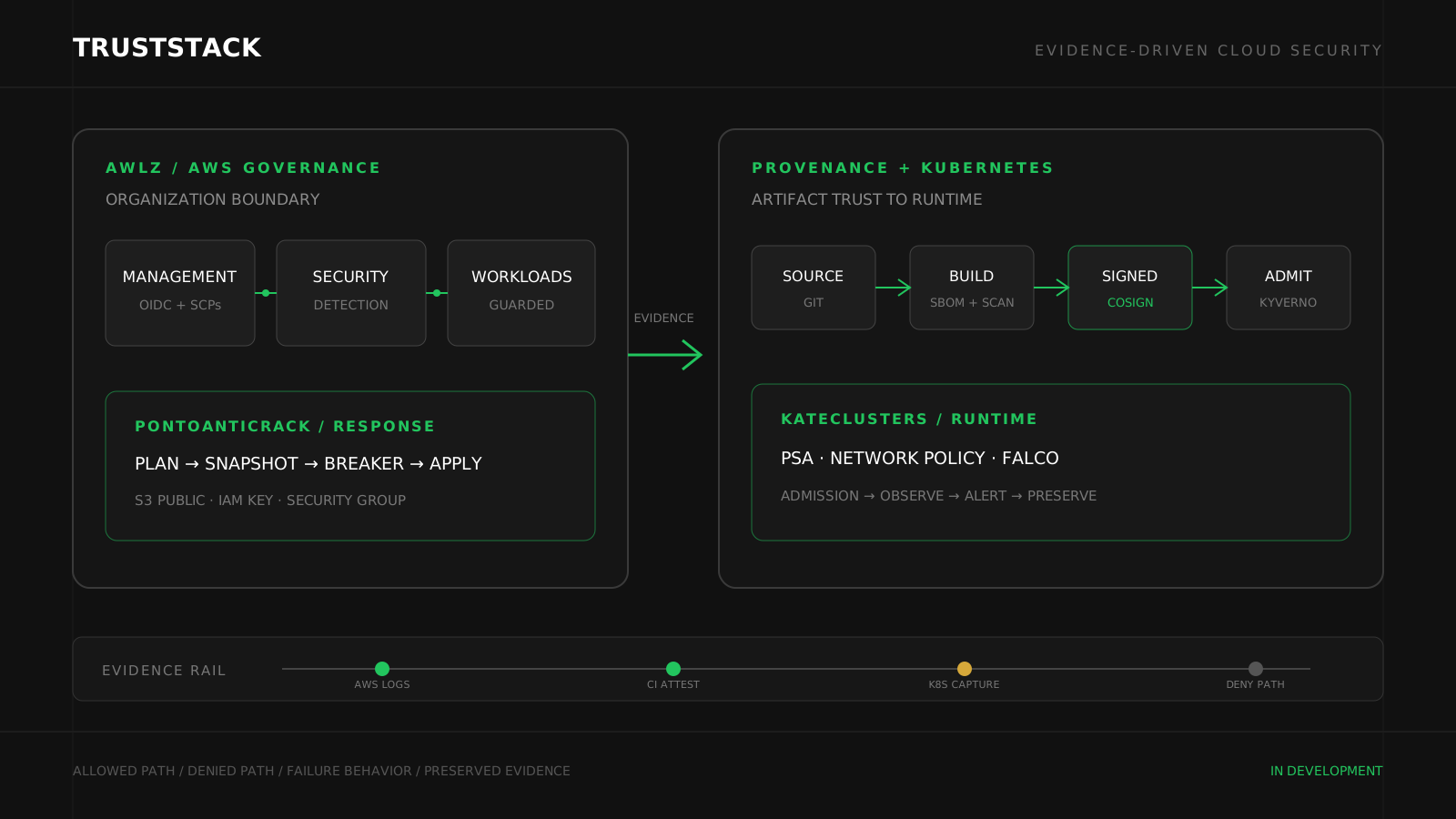
TrustStack is four public repositories that each answer one question about a system's trust: can an account do something nobody watches (AwLZ), do I know where this container came from (ProvenancePipeline), if something breaks in does anyone find out (KateClusters), and when something is found what happens automatically (PontoAntiCrack). All four are applied to real infrastructure - a live five-account AWS organization, a real kubeadm cluster, and a signed release path into GHCR - and all four meet the same definition of finished, agreed before any of the work started: code applied, evidence artifacts committed, a recorded demo, a threat model whose residual risks are stated rather than implied, and a public repository.
THE RULE, AND WHAT IT COSTS - The deliverable is not working infrastructure. Anyone can apply a Terraform module or install a Helm chart. The deliverable is reproducible infrastructure plus evidence that the controls do what the documentation claims, including where they do not. The part worth reading in each repository is docs/evidence/, and the part worth reading there is the entries recording a control failing, a claim being wrong, or a number coming back worse than promised. That rule has a price: three of the four layers had to publish a result less flattering than the one originally advertised.
AWLZ - CLOUD GOVERNANCE - Six independent Terraform stacks and ten modules build a multi-account landing zone: two organizational units, five accounts, four service control policies, an organization CloudTrail whose Object Lock archive lives in a separate log-archive account under its own key, and GuardDuty, Security Hub, Config and Access Analyzer all delegated to a security account. Root credentials are deleted from every member account, so the only interactive way in is IAM Identity Center, and there are no static AWS access keys anywhere - CI plans through GitHub OIDC with a read-only role and applies through a role gated behind a protected environment. Every SCP was probed from inside a member account while holding administrator there, because an SCP is the only mechanism that can deny an account administrator and a test as anything less privileged would prove nothing.
PONTOANTICRACK - DETECTION AND RESPONSE - Detection-as-code with automated remediation, named after the anti-cheat: the game keeps running, the cheater gets caught and kicked. Three detections - public S3 exposure, leaked IAM keys, world-open security groups - each a complete unit of EventBridge pattern, Lambda handler, scoped execution role, fixtures, and tests for both what it catches and what it must not. Every detection runs through one runtime, and the order is the security property: plan read-only, honour the exclusion tag, snapshot to the audit table, check the circuit breaker, pass the dry-run gate, apply, close the audit record, alert. Handlers implement plan() and apply() and nothing else, so they cannot get the order wrong. 185 tests, and a measured 5.97 seconds from an attacker's API call to the offending rule being revoked.
KATECLUSTERS - KUBERNETES RUNTIME - A kubeadm cluster on a dedicated Debian 13 VM, hardened against the CIS benchmark from PASS 67 / FAIL 12 to PASS 86 / FAIL 0, with each remediation linked to the manifest that fixed it. Pod Security Admission at restricted, least-privilege RBAC, Calico default-deny networking, SOPS-encrypted secrets, and Falco watching syscalls through eBPF while the API server writes an audit log - both shipped by promtail into Loki, with Grafana dashboards, alerts, and a dead-man's switch that fires when Falco stops reporting. Then attacked on purpose four times: container escape, cryptominer, service-account token abuse, and killing Falco itself, each with the raw captured output committed alongside the write-up.
PROVENANCEPIPELINE - SOFTWARE SUPPLY CHAIN - Build, syft SBOMs in two formats, grype and trivy failing at CRITICAL with no soft-fail, push to GHCR, cosign keyless signature through Fulcio recorded in the public Rekor transparency log, then SLSA provenance and SBOM attestations - and a Kyverno policy in Enforce with failurePolicy: Fail that refuses anything it cannot verify. The deliverable is the rejection, not the pipeline: four images, one policy. Ours by digest is admitted. An unsigned image is denied. A genuinely Sigstore-signed image with a genuinely public Rekor entry is denied because the identity is not ours - a policy that only asked "is this signed" would have let it in. Ours by tag instead of digest is denied.
WHAT PROVING IT ACTUALLY FOUND - AwLZ's promised CIS before-and-after was not obtainable, so a control experiment ran on the throwaway account instead: measure with the guardrails, detach them from that account only, measure again, reattach. All 35 controls were identical in both states, because no CIS v3.0.0 control reads a service control policy - the original claim was measuring the wrong thing. PontoAntiCrack was fully tested and completely blind twice: a loop guard that matched on the principal ARN could be bypassed by anyone passing --role-session-name pac-anything, and a pattern built entirely from AWS CLI fixtures had never seen the legacy encoding of the same API, so port 22 was opened to the internet and the rule did not match. ProvenancePipeline's design assumption about which attestation the cluster can enforce turned out to be exactly backwards, and the correction is recorded as ADR-009 with the original left visible.
HONESTY, MECHANISED - Rules that are only written down stop being true within a month. Every fixture carries a provenance marker and the command that would capture the real event, and a test fails if the marker is missing or contradicts the detection metadata - that gate fired three separate times in the final session and was right every time. CI fails any pattern test with no negative assertion, because a pattern tested only for what it catches matches everything, forever, silently. Every scanner suppression carries an inline justification. Third-party CI actions are pinned to commit SHAs, not tags. PontoAntiCrack's evidence directory stayed empty for the entire build, with a README saying what would land in it, because a table of realistic-looking latency numbers would have been trivial to write and would have made every other number in the portfolio worthless.
COST - A hard shared ceiling of USD 20/month across the two AWS layers, with budget alerts at 85% and 100% of actual plus 100% of forecast; the cluster and the pipeline cost nothing, running on a local VM and free-tier CI. Security Hub was the lever: CIS v3.0.0 in all five accounts projected USD 24.77/month, over the ceiling, so the five-account configuration was kept alive only long enough to capture the control experiment and then reduced to the delegated security account - and what was lost is stated: there is no longer a live per-account CIS score.
WHAT THE FIRST CLOSED BILLING WINDOW SAID - The projection was USD 13.73/month. The first steady-state month, September 2026, measured USD 7.03 of usage - USD 7.31 invoiced - and the interesting part is not that it came in under. Measuring it correctly took two attempts. Grouping AWS Cost Explorer by service without filtering the record type sums credits into the same row as usage, so every service in the organization reported USD 0 - and a Config recorder that was healthily recording 325 configuration items was indistinguishable from a broken one. Filtered to usage only, July's real cost was USD 1.48 and credits covered all of it. The invoice said zero. Reporting that number alone would have understated the model by the entire amount it existed to measure.
Three lines of the model were wrong, and the reasons are worth more than the figures. KMS matched to the cent. Config was over-projected threefold because the estimate extrapolated a deployment day across a month - Config bills per configuration item recorded and per rule evaluation, and the boundary rules are change-triggered, so a month in which nothing changes bills nothing. Config cost tracks what an organization does, not how long it exists. PontoAntiCrack's nine CloudWatch alarms billed zero because nine falls inside a ten-alarm free tier the estimate never applied - which makes the tenth alarm free and the eleventh a cliff, so the next detection carries a cost the original table could not have predicted. And Secrets Manager was missing from the model entirely at USD 0.40/month: invisible rather than estimated low, which is the worse of the two failures.
The calendar item closed too. GuardDuty and Security Hub left their 30-day trials in late August, and September 2026 was the first month with neither credits nor trials. The cliff was small: Security Hub billed 870 compliance checks against the 2,760 the model assumed, because its 2x re-evaluation margin went unused in a month where nothing changed. That is also the remaining caveat - Config and Security Hub bill on change, so USD 7.31 is a quiet-month floor, and a month with real Terraform activity has not been measured.